|
|
|
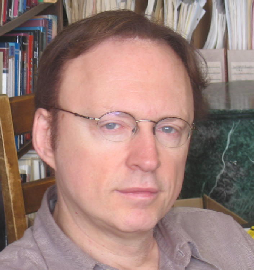
He received a PhD in Mathematics from MIT, and Bachelor's degrees in
Mathematics, Physics, and Psychology from Cornell University.
He has had appointments at Columbia University as Assistant and Associate
Professor (Computer Science, Mathematics), as well as at Harvard and at
MIT. He has served as departmental director of graduate studies at Boston University, and he is currently
affiliated with the Bioinformatics Graduate Program. He has published approximately 100
articles in mathematics and statistics, mathematical physics, computational
biology, and computational neuroscience, including two books. His
recent research and applications interests involve quantum probability and
information, statistics, machine learning, computational biology,
computational neuroscience, and complexity. He has recently pursued
research in quantum computation and information, and his current work in
machine learning has investigated complexities of designs for learning
machines and neural networks which improve, sometimes significantly, on
those for standard architectures.
Application areas of the latter include bioinformatics and genetic
transcription informatics. He is on
the editorial board of Neural Networks, and has been on the
organizing committee of the World Congress on Neural Networks twice.
He has had research grants and contracts from the American Fulbright
Commission, National Science Foundation, and the U.S. Air Force. He
has given approximately 100 lectures in 15 countries. Among
organizational roles, he has been a co-organizer for MIT summer analysis
seminars in Vermont, and the organizer of
a mini-symposium on Computational Complexity Theory in Chamonix, France.
|
|
Research: Mark Kon works in quantum probability and
information, bioinformatics, machine and statistical learning, mathematical
physics, mathematical and computational neuroscience, complexity theory,
and wavelets. His current research focuses on two areas.
The first is on questions in quantum probability, quantum computation
and quantum information. Quantum
computation promises to solve some long-standing optimization problems
arising in statistics and computational biology, including protein folding,
RNA structure, and DNA transcriptional activity. Quantum probability is related also to
questions having applications in statistical mechanics. These include questions related to
dependence/independence (entanglement) of quantum random variables, and to
ultimately to more general approaches to quantum computing methods
themselves.
A second area of study by Kon and his co-workers is in applications of
machine learning to bioinformatics and computational biology, in areas
ranging from inference of gene regulatory networks to identification and
classification of cancers based on gene variation, single nucleotide
polymorphisms, microRNA, and other biomarkers. Bioinformatic and
transcription informatics applications of statistical and machine learning
in fact have led to methodological and theoretical improvements in the
statistical approaches themselves, which have become important in several
aspects of these research projects.
These areas connect also with statistical complexity theory, neural
networks, and Bayesian inference, where similar issues are prominent. In this work Kon and his co-workers focus
on connections between the above statistical approaches, and more generally
on formulating more unified methodologies. One unifying goal is to
provide a general machine learning approach and algorithm set for the
analysis of gene regulatory interactions and transcriptional control.
Online Publications
Abstracts (in progress):
Number of visitors

|
|
|